


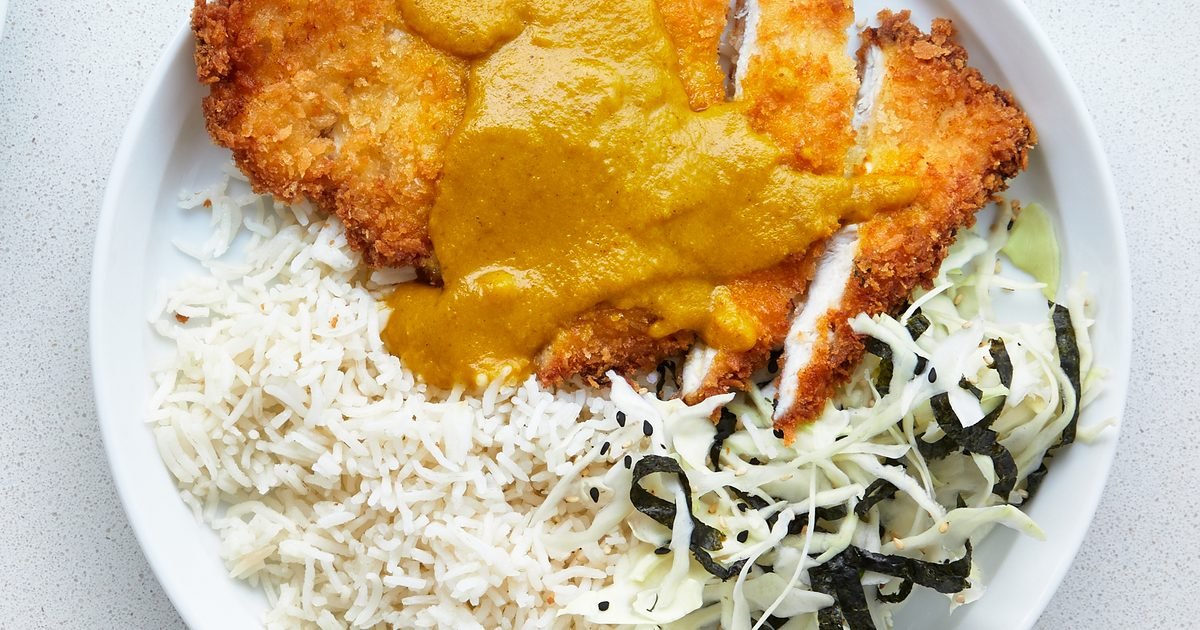
It’s easy to see why as a nation we’ve adopted this classic Japanese dish. The crunchy fried chicken delivers texture, while the accompanying curry sauce is warmly spiced and reminiscent of a chip shop favourite.
We’ve thought about the process of crumbing and added an extra step that makes the chicken extra crisp and tender. We’ve also taken on the Japanese concept of umami, meaning savouriness, and added layers of seasoning throughout the recipe.
1. Milking it
The milk in this recipe plays two parts: it works as a brine to tenderise the chicken and keep it succulent, and it also acts as a glue, helping the flour stick in the bread- crumbing process and ensuring a thicker, crisper coating.
2. Mighty miso
Add red or brown miso paste to give your sauce extra depth. If you don’t have any miso, add another splash of soy sauce instead.
3. Puréed veg
There are plenty of ways to make a thick Japanese curry sauce. We’ve opted to thicken ours with puréed vegetables rather than flour or cornflour, which can often lead to a gloopy consistency.
4. Freeze with ease
Our katsu and curry sauce both freeze well. Freeze the katsu between sheets of baking parchment to stop it sticking, then fry from frozen. Freeze the sauce in an airtight container and defrost fully before reheating.
5. Togarashi spice mix
This Japanese spice blend includes chilli, orange and sesame and is used as a seasoning. We’ve spiked the flour coating with it. Alternatively, you could use a sprinkling of mild chilli powder.
6. Season with joy
We’ve loosened the eggs for the breadcrumb coating with soy sauce, which both seasons and adds more umami flavour. This method also works when you’re making an omelette for egg- fried rice.
7. Panko perfection
Panko breadcrumbs are the key difference between katsu and schnitzel. Panko, made from crustless light white bread, are coarser than normal breadcrumbs and become extra-crunchy when fried.
8. Mix up the meat
This recipe can be made using flattened, boneless pork steaks in place of chicken. Pork loin steaks will give you the most uniformed, fat-free piece of meat to work with.
How to make it
Next level chicken katsu curry

Ingredients
For the katsu
- 2 large chicken breasts
- 400ml milk
- 100g plain flour
- 2 eggs, beaten
- 150g panko breadcrumbs or coarse dried breadcrumbs
- sprinkling shichimi togarashi or chilli power, plus extra to serve
- splash of soy sauce
- sunflower oil for frying
For the curry sauce
- 50g butter
- 1 large carrot, chopped
- 1 onion, chopped
- 4 garlic cloves, chopped
- large piece of ginger, chopped
- 2 tbsp mild curry powder
- 1 tbsp honey
- 1 tbsp ketchup
- 1 tbsp red or brown miso paste
- 1 tbsp soy sauce
- 1 chicken stock cube
- shredded white cabbage shredded nori, sesame seeds and cooked rice, to serve
Method
1. Cut each chicken breast in half lengthways, creating four fillets. Put each fillet between two sheets of baking parchment and beat with a rolling pin to even out the thickness.
2. Pour the milk into a bowl and season with a large pinch of salt, then add the chicken fillets. Cover and leave in the fridge for at least 20 mins or for up to 24 hrs (the longer you leave the chicken in the milk, the more succulent it will be).
3. When you’re ready to coat the chicken, tip the flour, eggs and breadcrumbs into three separate bowls, then season the flour with the togarashi and stir the soy sauce into the eggs. Scoop one chicken fillet out of the milk and coat in the flour mix, then dip into the egg mix and coat in the breadcrumbs. Set on a plate and repeat with the rest of the chicken fillets. Can be prepared up to a day ahead and frozen for up to a month.
4. To make the curry sauce, heat the butter in a saucepan and sizzle the carrot and onion for 5 mins, then add the garlic and ginger and cook for a few mins more. Scatter over the curry powder and cook for 1 min, then stir in the honey, ketchup, miso paste and soy sauce to create a sticky paste. Cook for 1 min more, then pour in 700ml boiling water and crumble in the stock cube. Cover and simmer for 20 mins until the carrot is soft. Tip the sauce into a blender and blitz until completely smooth (alternatively, use a hand blender). Season to taste. Can be made up to three days ahead and chilled or frozen for up to three months.
5. To cook the katsu, heat a good layer of oil in a large frying pan, then add as many of the chicken fillets as you can fit and fry for 3-4 mins on each side until deep golden and crisp. Transfer to a tray and keep warm in a low oven while you cook the remaining fillets.
6. Mix the cabbage and seaweed and sprinkle over some sesame seeds, if using. Top the katsu with the curry sauce and serve with the rice and salad, if you like.
