


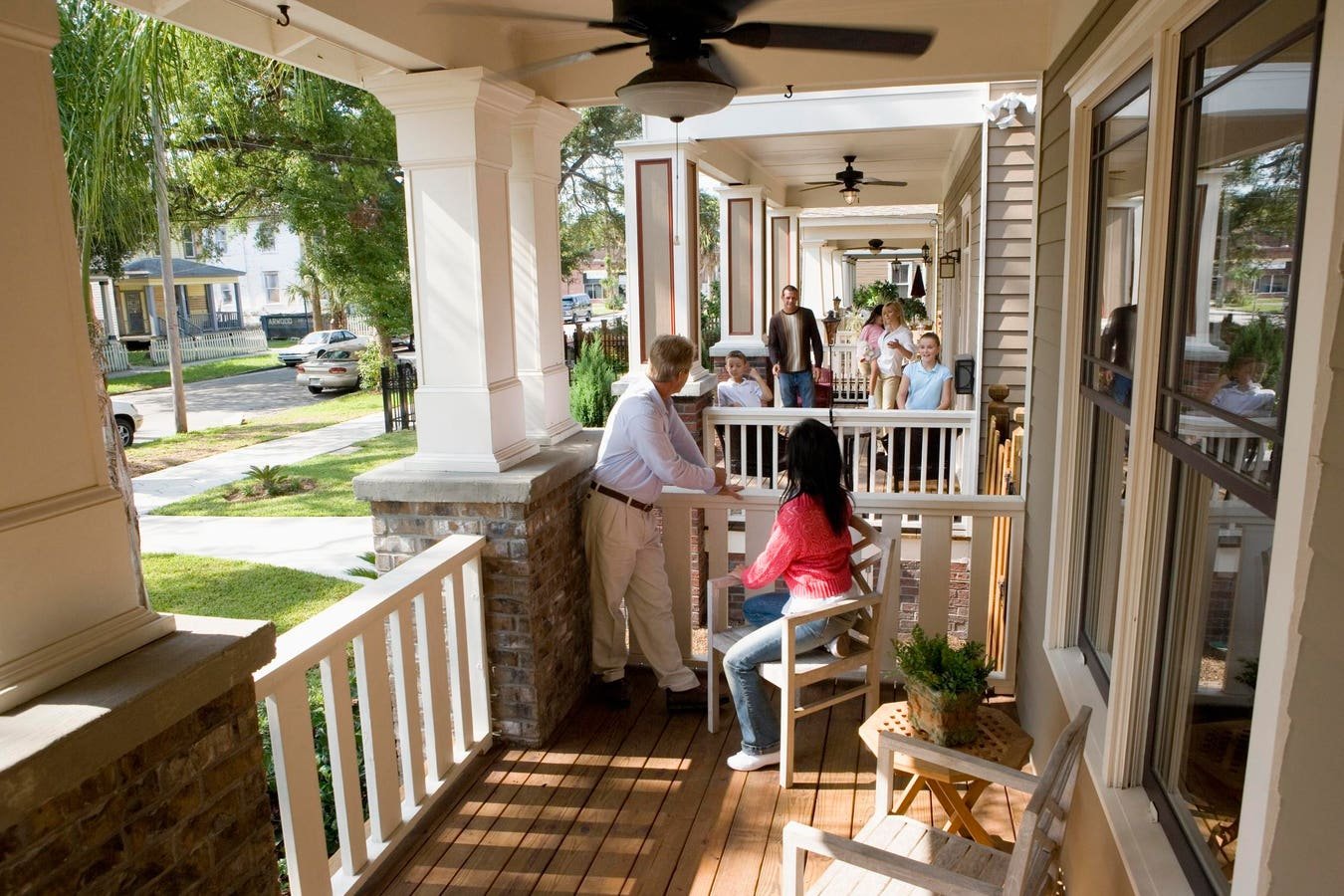

Front porch home designs invite socializing with neighbors.
getty
The Global Wellness Institute, a leading research resource for policymakers, analysts and writers on the international wellness industry, just released its 2026 Initiative Trends report. It covers insights from across its 27 thought leader groups, called Initiatives, including Wellness Communities and Real Estate. To quote the report’s forward: “The wellness real estate sector, now valued at $548 billion globally and projected to reach over $1 trillion by 2029, is the fastest-growing sector in the wellness economy.”
I don’t find that terribly surprising, considering the dramatic events of the past decade with more frequent and destructive wildfires and hurricanes than ever before, and a worldwide pandemic that drove home in the most painful terms possible the links between our living spaces and our lives. Which is why the current trend report from this sector is highly relevant to how we choose our neighborhoods and addresses.
I recently completed a multi-year home search to find a new single family home in a community I’ve found to be safe, walkable and neighborly. Apparently, I’m far from the only one doing so, here or abroad.
Members of GWI Initiatives span continents and countries, which is reflected in their perspectives. Here are five wellness community and real estate trends worth considering for your next home search.
Trend 1: The Wellbeing Address — Where You Live Is How Long You Live
“In the latest America at Home Study, 60% of all consumers cited health and wellness as the number one reason they desire certain home features, up 17% from two years prior,” the report writers shared, noting that it’s a market-wide demand signal reshaping how developers and investors approach real estate at every scale.
Consumers want environments that actively support their health, wellbeing and longevity, the study reveals, leading to communities with preventative medicine facilities on site and personalized health protocols incorporated into the spaces. Healthspan, (which describes the length of healthy, independent life, not merely how long one exists), is becoming embedded in the real estate infrastructure and wellness is an expectation influencing site selection, programming and operations. As the study points out, “The built environment is not just a backdrop to life, but an active participant in how well and how long we live.”
What that could look like in selecting a neighborhood and home is its access to quality local healthcare, to nature — especially walking or cycling trails and benches for relaxation — fitness amenities, healthy food selections, and gathering spaces for mental and social health.
In the homes themselves, it looks like the ability to incorporate circadian lighting, customize climate controls, manage indoor air quality and privacy, enhance resilience with microgrids and superior construction and have easy in-person access to culture and education.
Trend 2: Land First — When The Site Becomes The Strategy
“A meaningful shift is taking place in how wellness real estate projects begin. Instead of acquiring a site and layering amenities onto a cleared parcel, a growing number of developers are starting with the land itself, its ecology, agricultural capacity, water systems and cultural assets, and designing real estate in response to it. The land is no longer a backdrop. It is becoming the framework,” the study observes.
This has included farmland, vineyards and cultural assets, with the land becoming the framework for the community and no longer merely a backdrop. Farm to table is no longer limited to the gourmet café downtown. It can be from your community’s lands to your kitchen table.
Does this mean that everyone will be moving to “green acres”? No, but access to healthy, fresh produce and protein is being prioritized. Expect more micro-farmer’s markets close to or even on site at new communities, rooftop or courtyard community gardens, neighborhood food co-ops and home features like whole house purified water systems and induction cooking appliances.
Trend 3: The Three Rs — Rest, Reset, Rejuvenate
“People are seeking environments that actively support recovery, downtime and nervous system regulation as part of daily life. This is not a retreat from wellness. It is its maturation,” the study proclaims. Gen Z and Millennial buyers are prioritizing unplugging and in-person connection, the authors add. (I can see this for older buyers too. It was certainly among my house search priorities.)
“Developers are responding with projects where rest and recovery are treated as programmable infrastructure — dedicated quiet zones, sensory-calibrated spaces for decompression, biophilic circulation paths, flexible micro-spaces for solitude and community programming built around restorative practices.” The study authors tie the trend into one the Wellness Design and Architecture Initiative identified too: neuroscience as a home and community enhancer.
How that shows up in real estate, according to the study writers, is this way: “In an era of chronic overstimulation, the ability to offer genuine rest and recovery is becoming a competitive differentiator. Communities designed around life balance are seeing stronger resident engagement, and the rest ethic is emerging as a complement to the wellness features the market has already embraced.”
Trend 4: Wellness Finds The Middle Market
I love this one! The study correctly observes that “Wellness real estate entered the market from the top. Most early projects have lived in the luxury segment.” This is how most architectural-related trends begin. Then they become popular and “democratize,” as I put it, with more affordable options emerging in the market. The study authors are seeing this democratization in wellness real estate, I’m glad to report: “The severe global housing supply gap, growing inequality and rising consumer demand for healthy homes at attainable price points are creating what may be the sector’s biggest unmet opportunity.”
They point to master-planned communities developed for a larger swath of buyers who fit into the middle income category. They don’t have — and likely don’t need — the high end amenity packages offered at the high end. Instead, they offer green space access, healthier building materials, walkability and social infrastructure, like gathering spaces. As the report correctly points out, “Wellness design principles (walkability, biophilic elements, clean air, community connectivity) do not inherently require a luxury price tag.”
Trend 5: From Smart Homes To Sentient Neighborhoods
Artificial intelligence is helping developers identify community programming to activate shared wellness experiences. Yoga class? Healthy cooking demo? Weekly farmer’s market? “Community platforms are identifying which fitness classes, social gatherings or wellness resources residents engage with, and adapting offerings in real time,” the study comments.
Neurodesign is also playing a role in how spaces are designed, the authors add. When environments are planned with mental and physical health and the AI-driven community programs are working well, the overall environment is enhanced, the study concludes. Privacy and data governance will need to be addressed, but the next generation of wellness communities will learn and evolve with their residents, according to the authors.
Trend 6: Designing Against Loneliness
“The US Surgeon General’s 2023 advisory on loneliness and isolation spotlighted what researchers have documented for years — the built environment is an active agent in shaping, or preventing, social connection,” the authors declare. This principle is being adopted by master planned community developers, they share.
How this looks in real life are homes with front porches, walkable paths that create social encounter opportunities, programming and social spaces that encourage gathering. Developers are recognizing that social connection is a design decision that enhances resident satisfaction, community health and their own bottom lines.
Last Words
If your house hunt takes you to one of these communities with wellness features, it can enhance not just your living situation, but your life overall.
