


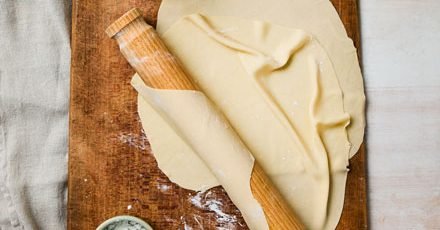

Irina’s tips for making filo pastry
Work environment: filo dough reacts to its environment. Work in a warm room (ideally 22-25 C). In a dry kitchen, lightly cover the rolled-out sheets with a damp tea towel to prevent the edges from drying out.
Make ahead: the dough can be prepared up to 48 hrs in advance. To store, put a sheet of filo on a sheet of baking parchment and dust generously with cornflour. Stack the remaining sheets on top, dusting generously with cornflour between each layer. Cover with another sheet of baking parchment, fold it over loosely, then wrap and seal in a reusable food bag. Chill until needed, or for up to 48 hrs.
Resting is essential: leaving the dough to rest relaxes the gluten, making it easier to roll out thinly without resistance or tearing.
Rolling pin: a long, thin rolling pin (such as an oklava) can make rolling and stretching the sheets easier, especially for large rectangular filo. But, a standard rolling pin works perfectly well.
Rolling order: work from the centre outwards, not edge-to-edge, to maintain even thickness and prevent tearing.
Minor tears are fine: small holes or tears will disappear once the sheets are layered. If the dough resists or tears excessively, cover and rest for 5 mins before continuing.
Dusting: use cornflour sparingly when rolling out – a light, even layer prevents sticking without drying out the dough.
Thickness: sheets rolled out to a 1-2 mm thickness are already suitable for filo and can be used as they are.
Optional stretching: confident cooks can gently hand stretch the sheets further, if desired. Use your fingertips to work from the centre outwards, rotating as you go, until the dough is almost transparent.
Handling large sheets: when stretching large rectangular sheets, rotate frequently and lift gently using the rolling pin, rather than dragging, to avoid sticking and tearing.
Trim edges: trim uneven edges for a neat finish. Don’t discard the trimmings – they can be layered and baked alongside the sheets or used in soups as a quick fresh pasta substitute.
Using sheets: when making börek/burek or layered pies, brush each sheet lightly with olive oil or melted butter for a crisp, golden finish. For baklava, brushing is optional if you plan to pour over syrup after baking.
