


Cosy season may instantly warm us to the idea of thick, steaming bowls of dal, but these curried lentils don’t always have a reason or season. Growing up in India, no meal was complete without dal. Many families are partial to a handful of recipes particular to their community, but mine had no issues with cultural inspiration or much care for convention.
We would dive into south Indian sambhar one day, north Indian kali dal another and Bengali roasted moong lentils the next. The one that made a routine appearance at weddings and special occasions was cholar dal, a rich chana version with raisins, coconut shards and ghee, finished with a light sprinkling of sugar. At home, we were partial to a simply sublime version made with moong lentils from my mother’s Delhi side of the family. We christened it Berry dal, after their surname.
Berry dal was the very dal I was taught to make before I left home in Kolkata at the age of 18 for university in England. It was the cultural culinary equivalent of ‘boiling an egg’. Sadly, no one showed me how to make the rice or roti to accompany it, so I did boil a bag or 200 in my early diasporic days. How I went on to write two Indian cookbooks remains a mystery to some members of my family.
The early painstaking lesson in making dal stood me in good stead to get the spices rolling. There is an art and science to making dal: some corners can be stirred and some hard nos. For a start, it accompanies a carb – pick your rice or flatbread of choice, there is no judgment here. It needs to have carb-friendly flow, so thicker for bread scooping and runnier for rice and grains. But, if you proceed to drink dal soup, you will go straight to cultural insensitivity prison.
Dal is not a soup, and where lentils are used to make them, they have special recipe names, like the south Indian Rasam. They are also never made with stock. Stock is only used very specifically in south Asian cooking, and never as a standalone ingredient to add flavour – our spices and ingredients are enough. This means you can’t forgo the final flourish that finishes a dal, or the tempering, called tadka, vaghar, phoron and more, depending on where the dal hails from. It would be akin to leaving seasoning out of a served dish.
It’s worth noting that some dal recipes do leave the tempering off, like the varan from Maharashtra or my mother’s special one-pot concoction. But, these are exceptions to a rule. If you leave tadka off a dal wilfully, you lose the right to call your lentil stew a dal. The end. Eat more dal.

How to make award-winning dal
- To make a great dal, we need to go back to the beginning. It starts with a good wash – unless you enjoy eating dust, grit and broken bits of lentils. Several changes of cold water may be needed until you can see your face reflected clearly in the water.
- You don’t need to soak lentils that cook quickly, but the ones that take longer, like chana or black lentils, do benefit from soaking for two hours (in warm water) or overnight. You can also cook it with a little baking soda to speed up cooking.
- The washed lentils are boiled in fresh, cold water. Any foam and scum arising needs to be skimmed and discarded. Turmeric should be added only after the water boils clear; otherwise, you’ll just be chucking it away. For a thicker dal, add water only when the liquid dries up. You’ll need to keep a kettle of boiling water ready so you don’t slow down cooking. Similarly, to keep the pace going, additional vegetables and ingredients are only to be added when the lentils are nearly cooked.
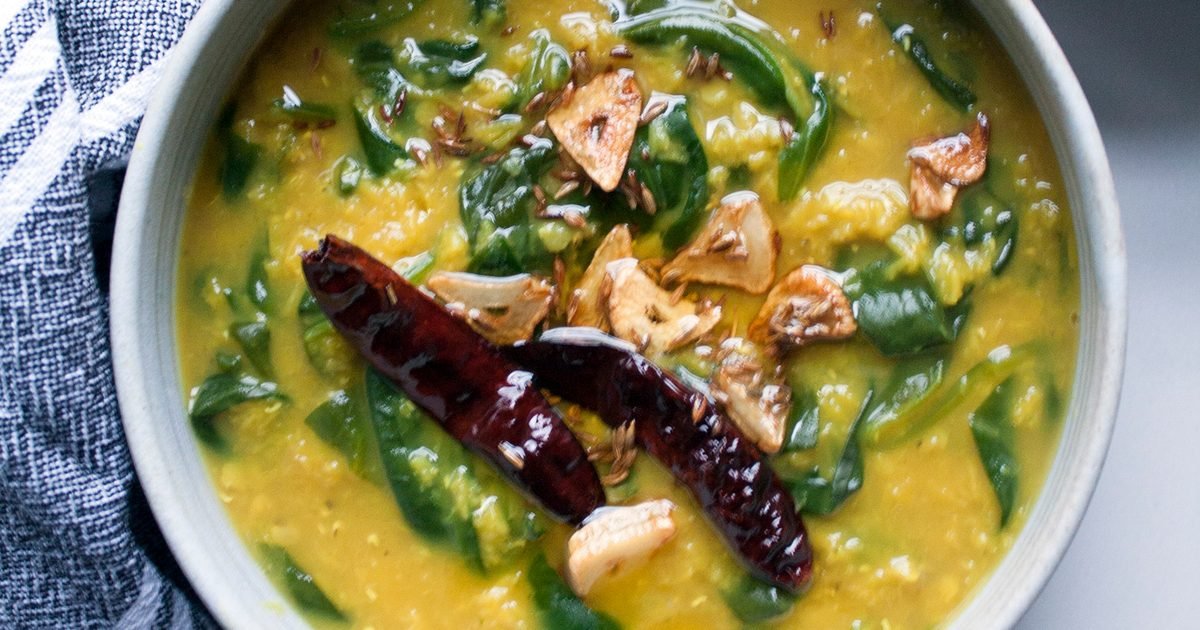
I’m sharing my homely version of a garlicky spinach chana dal that is very nearly a one-pot, save the small pan to make the tadka. It’s inspired by the luscious, thick dals of Punjabi dhabas found around Delhi. You’d normally cook the spinach and tomatoes separately and tip in the cooked lentils, but my method saves time and has just one saucepan to wash. The ghee is non-negotiable, but if you don’t have it, butter will do at a pinch for that unctuous finishing touch. This one is best with naan, so warm some ready for dunking.
Garlicky spinach chana dal
Serves 4 | Prep 15 mins plus overnight soaking | Cook 50 mins
For the lentils
- 200g chana lentils (Bengal gram)
- ¼ tsp baking soda
- 1 tsp ground turmeric
- 1 medium tomato, roughly chopped
- 150g frozen spinach, defrosted
For the tadka
- 1 tbsp ghee (solid)
- 2 small dry red chillies
- 1 tsp cumin seeds
- 2-3 garlic cloves, peeled and sliced
- ½-1 tsp chilli powder
1. Soak the lentils for at least 2 hrs and up to overnight. Wash them and set to boil with about 1 litre cold water and the baking soda. Remove the arising foam until the surface is clear, then mix in the turmeric.
2. Bubble gently for 20 mins until you can squish a lentil between your fingers easily. Now, add the tomatoes and the spinach. Cook for another 15 mins, stirring regularly and squishing the lentils against the side of the saucepan to thicken the dal.
3. Add a splash of hot water, if the lentils need it to remain liquid, and cook. Mix in salt to taste and turn the heat off when done. Leave it in the pan, or ladle it into your serving bowl.
4. Then, make the tadka. In a small pan, melt the ghee over a medium-high heat until it melts. Add the red chillies and, as they sizzle, the cumin seeds, garlic and chilli powder. You’ll need to work quickly so the spices don’t burn. Turn off the heat and pour the tadka over the cooked lentils.
5. My granny’s tip is to spoon a little dal back into the pan to nab any tadka left behind, before tipping it back into the dish. Serve with those warm naans.
This will go in no time, but if you do decide to make extra for another day, freeze the dal before adding the tadka. That way, you get the full hit of the aromatic spices when you defrost a box for another meal, ready in minutes.

Enjoyed this? Discover more inspiration…
Delicious healthy curry recipes
Top 10 veggie curry recipes
Best side dishes to serve with curry
How to make Thai curry and curry paste
Our top curry recipes
Chilli con carne recipe collection
