


For Kishwar Chowdhury, cooking Bengali dishes for her family is an intentional way of staying connected to her culture.
The household rotates between cuisines, but Bengali is on the menu at least two or three times a week, she says.

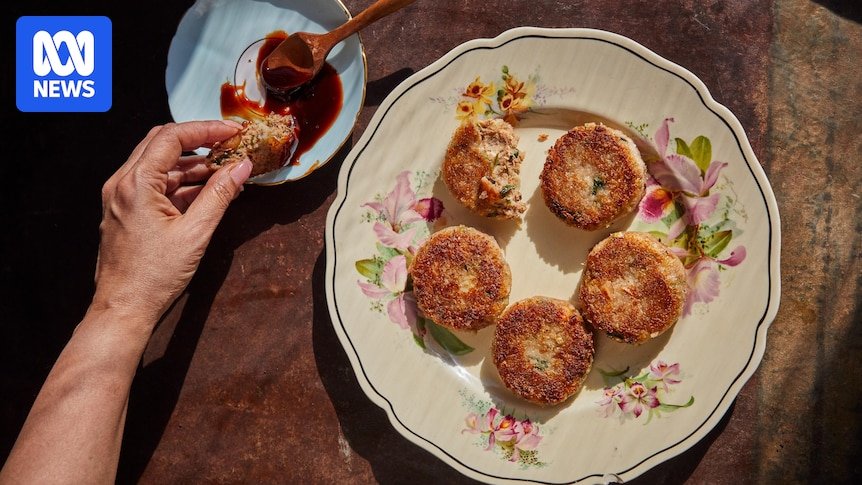
Kishwar Chowdhury loves tinned fish, but the ingredient is sometimes “frowned upon”. (Supplied: Hardie Grant Books/Armelle Habib)
“I don’t think I would have been in touch with the food and the culture and known it so deeply, if my parents didn’t [cook Bengali food].”
Kishwar says her tuna kebab recipe — which is similar to a tuna pattie or croquette — is the “perfect example” of how first-generation migrants learnt to creatively combine traditional and local ingredients and methods.
Inspired by a Bengali dish that requires deboning fresh mackerel and tuna, variations using affordable and accessible tinned fish are common across the diaspora, Kishwar says.
This is a “really forgiving recipe” and you don’t need to crack open an expensive tin of fish to enjoy it.
Tips:
- Tuna packed in olive oil works best in this recipe, as tuna in spring water can be a little dry in texture, Kishwar says.
- You can think of gorom moshla — a spice blend that includes cumin seeds, coriander seeds, cloves and cardamon pods — as a Bengali version of garam masala, which is also an easy substitute.
- Similarly, chaat moshla spice mix can also be subbed for chaat masala.
- Kishwar recommends preparing a big batch of the mixture, freezing the patties between sheets of baking paper, and then frying them as required.
You can dip them in egg and roll them in breadcrumbs before freezing, then fry them from frozen, or for ultimate crispiness you could crumb coat them a second time just before frying, she says. - If frying isn’t for you, the kebabs can be cooked in the air fryer. Kishwar recommends following the cooking instructions you would for a chicken nugget. “Ultimately it’s cooked, you’re just trying to get some colour on it.”
- Already cooked leftover kebabs, can also be reheated in the air fryer.
- You can shallow fry small batches in a traditional flat disc shape, just be sure to flip them for two crunchy sides.
- If you’re cooking for a large group, Kishwar says she tends to shape the mixture into round golf ball sizes and deep fry it instead.
- Oil with a high smoking point, like vegetable or canola, is good for frying.
- Serve with your favourite hot sauce or tetul’er chutney (tamarind chutney) as an appetiser or as part of dinner.
Sat 30 May 2026 at 12:00pm
