


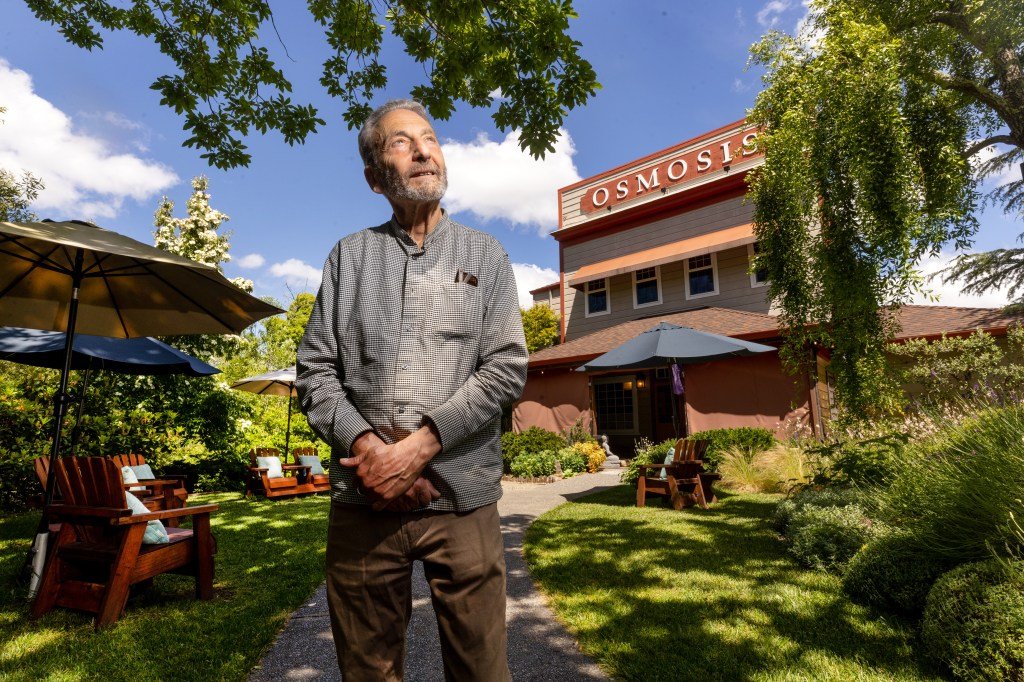
A landmark West Sonoma County wellness retreat widely known for its cedar enzyme baths and Japanese meditation gardens has transferred its operating assets into a perpetual purpose trust, a legal structure designed to permanently protect the spa’s mission, culture and guest experience from future sale or mission drift.
Freestone-based Osmosis Day Spa Sanctuary announced Thursday that it has placed its operating assets — though not the underlying 5.5-acre property itself — under the newly formed Osmosis Sanctuary Trust, making it one of the first U.S. wellness businesses to adopt such a structure.
Founder Michael Stusser said the move grew out of concerns that conventional ownership models could eventually erode the spa’s founding vision.
“If mission really matters, it can’t be contingent on any single person’s character, including mine,” Stusser told the Journal.

Emerging way to exit a business
Perpetual purpose trusts — also called steward-ownership structures — have roots in European ownership models (such as Bosch and Ikea) and are gaining attention in the U.S. as alternatives to traditional business exits, notably with Organically Grown in 2018 and outdoor wear maker Patagonia in 2022, according to Family Business Magazine and top trust attorney Ellen Harrison.
The Purpose Trust Ownership Network lists several dozen U.S. companies that have made the shift, including Sausalito’s Heath Ceramics, which formed a purpose trust this year.
Unlike employee stock ownership plans (ESOPs) or employee ownership trusts (EOTs), perpetual purpose trusts (PPTs) do not primarily exist to transfer wealth or equity to workers, though employees may still benefit operationally.
Downsides to perpetual trusts include creating governance ambiguity, reducing market discipline, and concentrating authority among trustees or stewards without the accountability mechanisms found in conventional shareholder systems, but other upsides can be protecting mission-driven organizations from short-term profit pressures, according to Family Business Magazine.
Osmosis’ transition follows years of succession planning and exploration of alternative ownership structures. It previously established a B Corporation entity and worked with Berkeley nonprofit Project Equity to study employee ownership and cooperative models, but leadership ultimately concluded those approaches would create governance and operational burdens ill-suited to a labor-intensive hospitality business already operating at capacity.
A potential management buyout was also considered after longtime leader Heather Bishop expressed interest in purchasing the business. But Stusser and advisers worried debt obligations could eventually pressure the spa toward profit-maximizing decisions at odds with its mission-centered culture.
Those concerns led Osmosis to the perpetual purpose trust model, an increasingly discussed ownership structure used by some mission-driven companies seeking to preserve organizational values indefinitely.
Building a trust
Under the arrangement, the trust becomes the steward of Osmosis’ central mission and operating principles, while management and staff continue running day-to-day operations. The company said the structure includes a trust stewardship committee and an independent trust enforcer intended to ensure future leaders remain aligned with the organization’s founding purpose.
“We haven’t changed Osmosis. We’ve changed what Osmosis is accountable to,” Bishop, now CEO, said in the news release. “This new structure takes that invisible commitment and makes it visible.”
The trust is designed to preserve the integrated guest experience that has defined Osmosis for four decades: cedar enzyme baths, Kyoto-inspired gardens, massage treatments, retreats and the quiet atmosphere cultivated across the wooded Salmon Creek property.
“What we’re doing now is evolving the very foundation of how a business like this can exist,” Stusser said.
Osmosis traces its roots to Stusser’s travels in Japan during the early 1980s, where he studied ancient gardening traditions in Kyoto and encountered cedar enzyme baths through a local Buddhist temple community. He returned to Sonoma County in 1984 and began building a rudimentary bath operation on a 9-acre ranchette using recycled materials.

A cedar enzyme bath at Osmosis Day Spa Sanctuary where over half a million people have enjoyed a treatment since it first opened in 1985. Photo taken Thursday, May 28, 2026 in Freestone. (John Burgess/The Press Democrat)


1 of 5
A cedar enzyme bath at Osmosis Day Spa Sanctuary where over half a million people have enjoyed a treatment since it first opened in 1985. Photo taken Thursday, May 28, 2026 in Freestone. (John Burgess/The Press Democrat)
As demand grew, Stusser searched for a property with both natural beauty and commercial zoning. He eventually acquired the historic Freestone parcel, which he said had fallen into disrepair before being transformed into the sanctuary visitors know today.
The spa’s early development depended heavily on local business mentors, including banker Pat Kilkenny, accountant Reuben Weinzveg and financial adviser Bruce Dzieza, who helped secure financing during the company’s precarious early years.
Today, Osmosis employs about 90 people, including more than 40 massage practitioners plus bath attendants, estheticians and groundskeepers. The business has also expanded beyond spa treatments into small-group retreats, workshops and garden-centered programming near Salmon Creek.
Stusser said the company expects its strongest month ever in May, driven by its first public relations campaign that has led to national articles, influencer attention and continued word-of-mouth growth. The spa draws guests from Sonoma County, the Bay Area and beyond, many seeking what Stusser describes as a restorative one-day retreat experience.
The trust structure was drafted under Oregon law because California statutes currently do not fully accommodate the perpetual purpose trust mechanism Osmosis wanted to establish. Stusser worked with consultants Natalie Rittman-White of Purpose Owned and Peter Kohler of Stronghold Ownership, both of whom have advised other purpose-driven enterprises.
For Stusser, the transition represents both legal planning and personal reassurance.
“I am so at peace and so relieved knowing that it’s set now, regardless of what happens to me, it’s set when my time comes,” he said. “Osmosis is not going to miss a beat. It’s on a very intentional track.”
Jeff Quackenbush joined North Bay Business Journal in May 1999. Reach him at jeff@nbbj.news or 707-521-4256.
