


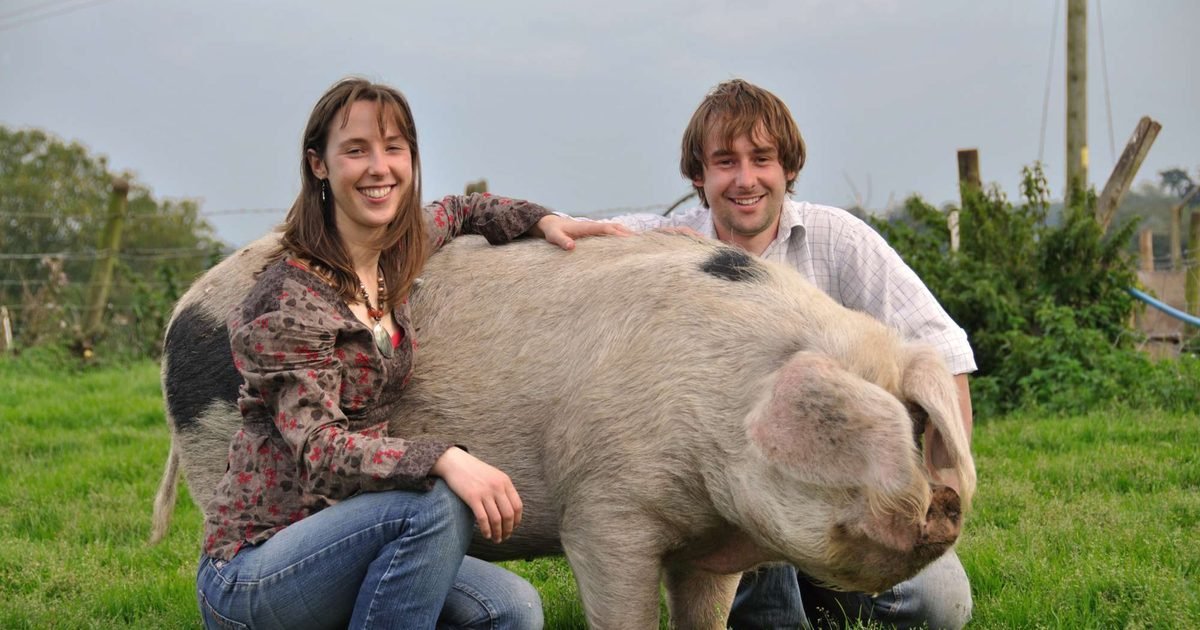
The farm that’s owned by 8,000 people
Sister-and-brother duo Charlotte and Ben Hollins rallied thousands of people to save their organic family farm in Shropshire, creating a community ownership model that is now growing with a second site. Charlotte tells their story:

I grew up at Fordhall Farm in Market Drayton. My brother Ben and I are the fourth generation of our family to farm this 140-acre site – our late father, Arthur, took over the tenancy in 1929 at just 14 years old. Back then, chemical fertilisers were promoted as miracle yield boosters, but Dad found that they depleted the nutrients in our sandy soil over time, weakening crops.
Inspired by woodland, Dad trialled what he called ‘foggage farming’. He planted over 70 species of grasses, herbs, shrubs and trees, creating a resilient system that let cattle graze year-round. The diversity rebuilt the soil’s health, provided natural vitamins and antivirals, reduced vet bills and cut our climate impact while producing nutritious food more affordably.
Despite Dad’s success, as tenant farmers, we were vulnerable. In the 1990s, our landlord issued eviction notices, hoping to sell the land for development. We fought it in court, but legal fees drained our resources. The farm deteriorated, livestock had to be sold and, in 2004, we faced a final 12-month eviction. At the time, Dad was in his 80s and exhausted.

Ben and I, then in our late teens and early 20s, converted a lean-to into a shop selling sausages to the public. We made £50 in our first weekend – a fortune to us! To survive, we took off-farm jobs and began involving the community through volunteer weekends and events, slowly building support.
After Dad’s passing, locals told us they wanted to keep the farm, but not farm it themselves – so Ben stepped up. We formed the Fordhall Community Land Initiative and sold £50 non-profit making shares. The landlord gave us first refusal for £800,000, but by the time we were legally incorporated, we had six months to raise the money. Through thousands of small contributions, we secured the land in 2006.
Today, 8,000 shareholders from around the world own Fordhall Organic Farm, forming an engaged community of ordinary people who care. Ben has a 100-year tenancy and farms using Dad’s methods, selling everything direct through his farm and online shops, strengthening local food security. Last year, he won the Golden Fork for Sustainability from the Guild of Fine Food.

I now work for the Fordhall Community Land Initiative. We run community and conservation projects on-site and, last year, the society announced it was to be gifted another farm.
Over 80 per cent of our members recently voted to expand our influence nationally. So, as wecelebrate 20 years of community ownership, we’re committed to using our learnings to support similar models. Research shows this approach aligns with UK pathways for stronger food resilience, benefitting farms, communities and the climate. But, the fight isn’t over. There’s still one 12-acre field that we’re trying to reclaim from the original landlord before they sell it for development.
For us, it’s about empowering people to influence their own food future. We’ve proven that ordinary folk can reclaim land, ensuring sustainable food production remains for generations.
Food for thought
• No experience needed Focus on what your community cares about and needs, then experiment.
• Get people involved in ways that suit them Whether it’s donating £50 or spare office supplies, small actions from many will help you climb big mountains.
Find out more
• For more about Fordhall Farm, community ownership and becoming a shareholder, visit fordhallfarm.com
• Check out the Food, Farming & Countryside Commission website to learn more about resilient farming (ffcc.co.uk)
The charity teaching food skills and sustainability
Andrea Devine-Clark is a cook club instructor at The Fifth Trust, a charity that supports adults with learning disabilities in Elham Valley, Kent. The students can also get involved in growing veg, tending the vineyard and working in the café.

I was brought up on canned things – my mum doesn’t cook at all, so ‘greenery’ was canned peas. Now, I love kale. At The Fifth Trust, we make kale crisps – we try to move away from just biscuits and cakes, and make healthier options for our students.
When we’re teaching recipes, we focus on repetition and building up skills so students can try it at home. If we overcomplicate it, confusion can set in. When we’re making something new, I’ll ask, ‘How does that smell?’ We eat with our senses, so it’s nice to invoke that. One of our students, Hugh, might tell us that he ate this when his dad was alive – food pulls in memories, and we can capitalise on that, maybe asking, ‘Would you like to share more about that?’
We get about 75 per cent of our produce from our own garden. Laurence, our horticulture instructor, tries to keep it sustainable, so no chemicals, no dig. Anything we can’t use is sold in our garden centre or donated, and we also use our freezers a lot for storage.

We help students understand where food comes from. They see veg with dirt on it and understand that it isn’t safe to use in that state, but when we’ve washed it, the skin will be good, because it won’t have any chemicals on it. We even make crisps with the peelings.
Winter was hard this year – it was so wet – but now it’s warmer, Laurence will send down herbs and we make pesto for the café. We also have lettuce, spring onions, tomatoes, beetroot and peas.
Some of our students come in wheelchairs, and the kitchen isn’t very accessible – they can be at the tables, but not at the cooker, so we want to upgrade. We’d also love to produce an accessible cookbook with pictures and symbols that make it easier for people in the learning-disabled community.
Food for thought
• Don’t rule out veg you dislike Try cooking it differently or combining it with spices. Look for inspiration in cookbooks, magazines and online.
• Reduce food waste Use carrot tops in pesto, turn parsnip peelings into crisps and add roasted squash seeds to salad.
• The compost heap is ‘the engine of your garden’ Laurence says that even the smallest garden can fit in a compost heap. All you need is a mixture of browns that have high carbon content (like dead leaves) and greens that are high in nitrogen (like veg scraps).
• Start with potatoes or low-maintenance perennials …like blackberries, if you’re new to gardening. Brassicas like cabbages and broccoli are easy to grow but hard to keep alive – you’ll need to cover them with nets. Above all, grow the things you want to eat.
Find out more
• For more information about The Fifth Trust, visit fifthtrust.co.uk
The greengrocers bringing food back to the heart of a town
In Carrickfergus, Northern Ireland, Lee Robb helped create Carrick Greengrocers – a community-owned project that shows how local produce can revive towns.

I grew up in Carrickfergus and, like many of my generation, left it. When I returned years later, I barely recognised the place – unemployment had risen and the high street felt hollowed out.
For a long time, I didn’t feel able to do much about it. I was a single parent commuting into Belfast for work and feeling disconnected from the place where I lived. But, when my daughter left home and I was made redundant in my early 40s, I began asking myself, ‘Where do I want to live, and what do I want to contribute?’
I talked to neighbours and community groups, asking one simple question: what would you like Carrick to feel like? People were ready to talk – in fact, it felt as though everyone had just been waiting for someone to ask.
To keep the conversation going, I set up a Facebook group, Positive Carrickfergus, which turned into action. We organised a shared lunch in the town hall, for which 14 women volunteered to cook. More than 100 people came and many passersby wandered in.

During lockdown, we delivered postcards to 10,000 homes, asking residents what they wanted for Carrick. The desire for a livelier high street came up again and again, but so did food. People spoke fondly about the greengrocers that once lined the town centre. The big supermarkets had pulled people away from the town centre, but there was a shared belief that Carrickfergus could support something better. Slowly, the idea of a community-owned greengrocers took shape.
We raised money through a community share offer, inviting people to co-own the project with what they could afford. We hoped to raise £25,000, but reached £34,000. Eight months later, Carrick Greengrocers opened its doors.
In our first week, we expected takings of about £620, but we took £10,000 – it was a shock, but also validation. A big part of our success comes from how we source food: we work closely with a local market gardener just over a mile away, selling chemical-free, no-dig produce that’s harvested in the morning and on the shelves the same day. Customers taste the difference and value knowing where their food comes from.
We focus on food quality, choice and a high street that feels alive. Climate benefits come with that: shorter supply chain, healthier soil and a more resilient food system.
For me, the biggest lesson is vision. Decline isn’t inevitable – by looking around and asking what’s possible, you can start to tell a different story.
Food for thought
• Start by listening Change doesn’t begin with a perfect plan, but with asking people what they want.
• Work with what you have Skills, spaces and goodwill are often already there, just waiting to be connected.
• Build something real Tangible, sustainable projects create trust, momentum and a sense of shared ownership.
Find out more
• Follow Carrick Greengrocers on Instagram @carrickgreengrocers
Listen and get involved
For a deeper dive into Carrick Greengrocers and Fordhall Farm, listen to ‘Screw This… Let’s Try Something Else’, a new podcast series co-produced by Immediate and Antidote. You’ll hear ordinary people share practical ways to respond to big challenges, from inequality and housing, to food systems and the climate crisis. Find out more at antidotelive.studio/podcast or find a project near you at antidotelive.studio/near-you.
