


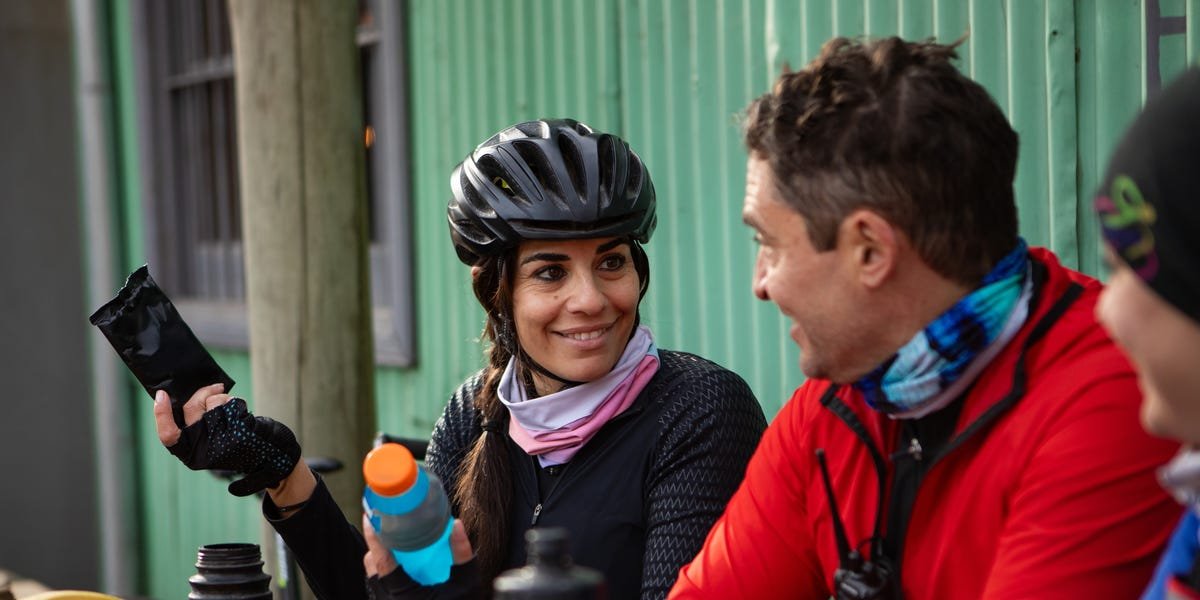
Despite all the attention that on-the-bike ride nutrition and hydration rightfully receive, research has shown that what you eat and drink after your ride is just as important in supporting your energy levels, your fitness, and how strong you feel on the bike.
In fact, leveling up your postride nutrition and hydration strategy may be one of the most effective ways you can improve your cycling performance long term.
“It’s so important to remember that we don’t get stronger when we’re training and working out, we get stronger when we recover. It’s so easy for people to think, ‘All I have to accomplish today is my workout and then I’m good to go,’” Uriell Carlson, RDN, registered dietitian nutritionist and owner of Inner Wild Nutrition tells Bicycling. “But actually, it’s barely worth doing your workout a lot of times—especially if it’s a hard workout and/or a long workout—if you’re also not setting aside time to be very intentional about your recovery.”
Nutrition and hydration are both a huge part of recovery. Having the right combination of nutrients in your postride meals and snacks gives your body the benefit of stimulating muscle repair, which is crucial in order for the body to build and maintain lean muscle mass. And maintaining muscle is important not just for cycling performance but overall health, especially as we age, considering we begin to lose between 3 and 5 percent of muscle mass with each passing decade after 30.
“It’s up to us to give our body the nutrition that it needs to get stronger, and it’s so easy for people to just be like, ‘I’m good to go, I’m gonna go shower, I’m gonna get on with my day and I’ll eat when I feel hungry,’ and that’s one of the worst things you can do,” Carlson says.
What Exactly to Eat After a Ride for Better Recovery
According to Carlson, carbohydrates should take priority over protein after a ride, contrary to the nutrition recommendations following a strength training session (though that doesn’t mean you should skip protein altogether!). “For endurance athletes, so for cyclists, it’s carbohydrates first and protein second,” she says. “The ideal ratio is four parts carbohydrates and one part protein.”
This should break down to about 1 gram of carbohydrate per kilogram of bodyweight (or 0.5 grams of carbs per pound of bodyweight). “So, if you are 150 pounds, you’d want between 70 and 75 grams of carbs after a ride,” says Namrita Brooke, PhD, RDN, sports endurance coach, registered dietitian, adjunct professor, and Bicycling advisory board member.
If you’re aiming for the 4:1 carb-to-protein ratio, that would also mean getting about 17 to 19 grams of protein along with those 70 to 75 grams of carbs.
Also, go for more complex carbs than what you’d eat before a ride, which is typically fast-absorbing carb options. “Adjust your post-training meal according to the work done during your training: Keep eating carbs, but change the source to slower-absorption sources, maintain protein, and don’t forget about fruits and vegetables that will help you to recover,” Anna Carceller, Ph.D., M.D., team nutritionist for EF Pro Cycling tells Bicycling.
Examples of postride recovery foods recommended by Brooke and Carceller that meet these recommended carbohydrate and protein needs include:
- 1 cup vanilla Greek yogurt with berries and granola
- 1 bowl of oatmeal with 1 peach, ricotta cheese, ½ tablespoon of lime juice, and chopped fresh mint
- ½ cup of rice or pasta with sliced chicken breast the size of the palm of your hand and 1 piece of fruit
- 1 small bread roll with a 2-egg omelet and fresh cheese
- Smoothie with 20 grams of whey or plant-based protein, milk of choice, frozen banana, and frozen mango
One of the most important things is to make sure you enjoy what you eat, Carceller says.
“On special days, or just to mix things up, we include other sweet options like flapjacks, sweet potato cakes, or homemade muffins [in the postworkout meals of pro athletes],” she says. “The key points are to focus on carbs, have a bit of protein, and don’t forget to put color in your recovery—raspberries, strawberries, blueberries, mango, pineapple!”
How to Hydrate After a Ride
Just like hunger signals may be a little funky after a ride, we may also not feel particularly thirsty. But this is another case in which you should take something in anyway to help your body repair itself for the next ride, as dehydration can leave you feeling sluggish.
“For active individuals, optimal hydration is critical before, during, and after exercise. Restoring hydration after physical activity improves recovery and reduces symptoms of dehydration, such as headache or fatigue,” Samuel Sarmiento, MD, MPH, MBA tells Bicycling.
“While you can get very technical by calculating a person’s sweat rate to determine the exact deficit, most people can gauge their hydration level using certain cues. These include the level of thirst, urine color, frequency of urination, and bodyweight,” Sarmiento adds.
Also, just like your food intake, you also want to time your fluid intake for optimal recovery. “After a strenuous effort, the goal should be to replace up to 150 percent of the estimated fluid loss within four hours,” Sarmiento says.
A simple DIY method for estimating your fluid loss is stripping down and weighing yourself right before your ride and then again immediately afterward, taking note of any difference in weight and subtracting the amount of fluid you took in during the ride.
For example, if your weight was 180 pounds before your ride and 178 after your ride, you’ve lost two pounds, or 32 ounces of fluid. To replenish 150 percent of this estimated fluid loss, you need to consume 48 ounces of fluid (150 percent of 32 ounces). Be sure to subtract the amount of fluid you consumed during your ride to make this estimate as accurate as possible.
However, if you do want to get seriously technical about your hydration levels by calculating your personal sweat rate, there’s wearable technology available to help you do just that. Many pro cycling teams, including Human Powered Health and 2024 Olympic gold medalist Kristen Faulkner’s team EF-Oatly-Cannondale, turn to hydration sensors like Nix Hydration Biosensors ($129) and Hdrop Hydration Sensors ($250) to optimize their hydration in an arena where every performance benefit counts.
Whether or not your riding goals are remotely similar to those of pro athletes, prioritizing your fueling strategy after the ride will improve your recovery, and optimizing recovery off the bike is often the missing link in improved performance on the bike.

Natascha is an editor and writer covering health, fitness, and the ways people move through the world. She’s been a NASM-certified personal trainer for more than a decade, with a background in functional strength training, corrective exercise, nutrition, and behavior change. Her work has appeared in Bicycling, Runner’s World, and other outlets, and her experience spans both editorial and hands-on work across the fitness industry. Whether she’s writing about training, health, or performance, she’s most interested in making complicated topics useful, approachable, and helpful.
